SM 102
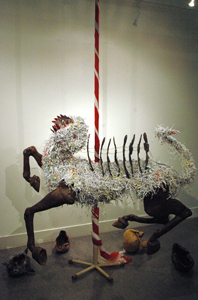
The Tiger
The Tiger. 2005.
Clay, wire, mesh, shredded documents,
crepe paper, steel, rust, Coke cans, chair base.
The tiger perhaps warrants a description. Over-determined as it is, its multiple metaphorical meanings could be lost.
Why a tiger? A paper tiger, metaphor for tiger without teeth, harmless. ‘Don't trust a smiling tiger’ - is that out of The Jungle Book? [i] Devouring, or being devoured. The paper tiger’s coat made out of shredded documents. Hobbs from the cartoon, a truly transitional object, a creation in the child's mind assisting with anxiety as art is a creation of grownups, assisting in the same way. Tiger as meta-comment on the process of art - a transformational object for the artist, but just an object for everyone else.
But it is not entirely tiger – the head is not a tiger head. Does an institution have a recognisable head? No, I think not. Institutions are all body. The head, if there is one, is infinitesimally small compared to the institutional body - a figure in a faraway city in some glass and concrete office block. But institutions do have teeth. They can bite and eat us, paper or not.
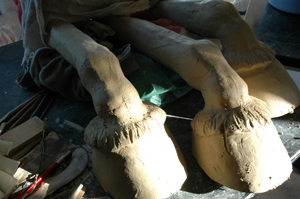
And the horses legs; because it is a monster. The horses of the Apocalypse, Durer’s drawings. The race of time, war, famine and death, perpetrated by the institutions of history. The scratches and gouges on the ceramic legs, the rusty scraps of welded metal that are the joints, the oversized hooves to crush underfoot.
The roundabout, a circling of events and time, carnival, hysteria, a combination of irreverence and screaming that is the only sane response. The braying donkey in the medieval church, and that painting of the carrousel with servicemen and women. [ii] On the tiger's back, the ordinary folk, the populace. Those paper dolls that are cut out in strings from folded paper. Gingerbread men, childish play, but incinerated black. Strung together and riding the tiger.
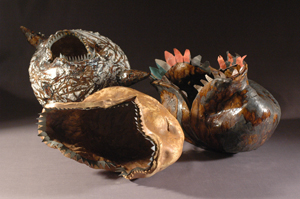
Four heads on the floor. One skull with blinded eye sockets and a wide-opening jaw, hinged with welded steel. Two forms that are all mouth, opening so wide that they almost snap back and devour themselves, shrieking hysterically with teeth from ear to ear. An old-fashioned mine, its spikes waiting to touch and explode, patinated with glazes of rust and barnacles, it’s wide open mouth full of small, sharp pointy teeth.
Why four heads? Perhaps because of the four horses of the Apocalypse. They wait there for those of the populace who fall off; waiting to devour, like sharks in the sea.
Interestingly, during the making of this monster with its threatening intentions, I somehow managed a transition from threatened to devourer. Filled with an immense sense of power, the tables were turned. I, Invincible, looked back through my transitional object, from the other shore.
Exhibiting Tigers (text)
[i] Rudyard Kipling, The Jungle Book (Saddleback Publishing, 2000).
[ii] Mark Gertler, The Merry-Go-Round, (1916). Oil on canvas. Tate Gallery, London. The Art Book (London: Phaidon Press,1996).