 M210
M210
M210
Abstract Expressionism and Agnes
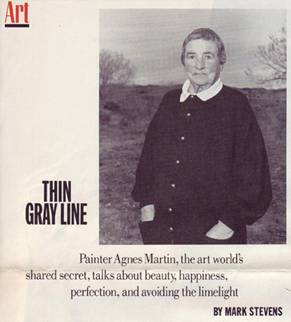
Image from
Vanity Fair. March 1989. Mark Stevens 'Thin Grey Line'
Art section article. page 50, 54, 56.
(Found as torn out magazine pages inside a second-hand book)
Critics who write of Agnes Martin’s work often discuss the minimalist appearance of her grids, the femininity of her pastel colours and delicate surfaces, or the spiritual aspects of her work so apparent in her writing. Agnes has at times aligned herself with the Abstract Expressionists however, due to their shared intention of emotionally affecting the viewer; so I decided to inspect what is written about some of her abstract expressionist peers, as a way of approaching her work, and possibly aspects of my own.[i]
Some of the main artists normally discussed under the heading of abstract expressionism include Arshile Gorky, Clifford Still, Willem de Kooning, Jackson Pollock, Franz Kline and Robert Motherwell. Those with whom her work had more in common were Mark Rothko and Barnet Newman, where geometry and colour predominated rather than gesture.
These expressionist works evolved from ideologies of the unconscious and surrealism, and the use of 'automatism' to access the unconscious self. The idea of the unconscious was particularly evident in their concept of self expression as it was believed that art could provide access to an authentic but concealed essence of self, so important to 'authorship'. In essays written at the time by Harold Rosenberg and Meyer Shapiro, beliefs were expressed regarding the artist’s uniqueness, the revelation of 'his' inner sanctum of feelings, of art revealing 'his very own self as the kernel of originality'[ii] with the assumption that 'the pangs of suffering registered by the art' are universally human and universally accessible.[iii] There was an emphasis on ego, but there also seemed to be an emphasis on suffering, of the tortured soul and the struggle and tragedy of lived experience. Authorship was emphasised through an artist's signature style, evident in the handling of brushwork, colours and form, which became recognisable trademarks and almost logos, and which 'trapped' artists into serial production of similar works. [iv] These artists also emphasised terms such spontaneity, and feelings of surprise over what they themselves produced. [v]
This was the origin and reality of abstract expressionism, commonly called the New York School, which Agnes Martin would have known in early 1950s America. But the terms 'abstract expressionism' are not always so closely attached to the unconscious and the ego. Robert Motherwell with his numerous 'Elegy to the Spanish Republic' paintings was exploring a subject other than himself, albeit within the repetition of his autographic style; and de Kooning’s subjects were figurative. In a sense, any metaphorical content in art must 'expresses' something, and bearing in mind the 'internal relationship' of the artist with the work, and the 'ontological reciprocity' of the artist with the world, it would be impossible to say that we are not 'expressing'. Similarly Agnes Martin may have used the term 'expressionism' fairly loosely when she applied it to herself.[vi] From this viewpoint her philosophy towards art seems to have consisted of an amalgamation equally of the abstract expressionist mode (with all its baggage) and an eastern Zen Buddhist philosophy of life.
Categorising Martin’s work as abstract expressionism does not seem fully to account for it however. Agnes has stated that 'personal emotions and sentimentality are anti-art,'[vii] and has also described her work as being in the classical tradition, representing the Ideal in the mind. 'Classicism', writes Agnes, 'is not about people, and this work is not about the world.' The ideal 'doesn’t exist in the world.' It is impersonal and detached.[viii] Initially these comments equating abstract works with the classical figurative art of ancient Greece are rather difficult to understand, but Lynn Cook clarifies the matter in her essay ‘'Agnes Martin' by explaining Martin’s work as having a classical attitude rather than a classical style.[ix] A discussion of Ad Reinhardt’s work also assists with an understanding of 'classical' in these terms. Ad Reinhardt was a close friend of Martin’s for many years, with a similar interest in Eastern philosophy and a similarly idealist stance. Reinhardt believed that art should maintain aesthetic purity, and distance itself from its applied derivatives, such as illustration and design. His ‘black paintings’ were renunciations in support of this aesthetic purity, which he described as being 'a free, unmanipulated, unmanipulatable, useless, unmarketable, irreducible, unphotographable, unreproducible, inexplicable icon. A non-entertainment, not for art commerce or mass-art publics, non-expressionist, not for oneself.'[x] Despite the fact that Reinhardt also insisted that his art was about nothing but art, like Martin he was at times interpreted as having metaphysical intentions.[xi] The temperament of their work was quite different however, for even though they both sought perfection, Reinhardt’s black renunciations make a strong contrast to Martin’s airy relinquishments of striving in the cause of happiness, beauty and the untroubled mind.[xii]
As regards my own work; I am somewhat relieved to find Martin freed from the tag 'abstract expressionist', and all the torrid emotions and egocentric introspection that this implies. Her ‘classical’ attitude, belief in intuition, and search for happiness rest comfortably against my own beliefs in the 'internal relationship' of artist and work, and occupation as homeostasis; even though the concept of perfection and idealism is a little too unified for our postmodern times.
see also
Agnes Martin
and
Agnes Martin Images
[i] Mark Stevens, ‘Thin Grey Line’ Vanity Fair (Conde Naste Publications, March 1989), 54. responding to the interviewer Mark Stevens - ‘My painting is more emotional and expressionist than minimal’.
[ii]Hal Foster, et al, Art Since 1900. Modernism, Antimodernism, Postmodernism (London: Thames and Hudson, 2004), 350.
[iii] Foster et al, Art Since 1900, 350.
[iv] Foster et al, Art Since 1900, 352.
[v] Foster et al, Art Since 1900, 350 and 354.
[vi]Stevens, Vanity Fair 54.
[vii] Herausgegeben Dieter von Schwarz, ed., Agnes Martin: Writings (Kunstmuseum Winterthur Edition Cantz, 1992), 154. Published to accompany the exhibition - ‘Agnes Martin: Paintings and Works on Paper’ 1960 - 1989 at the Kunstmuseum Winterthur, January 19 to March 15, 1992.
[viii]Kristine Stiles and Peter Selz, eds., Theories and Documents of Contemporary Art: A Sourcebook of Artists’ Writings (Berkeley, Los Angeles, London: University of California Press, 1996), 130-131.
[ix] Lynn Cooke, ‘Agnes Martin’, Dia Art Foundation. http://www.diacenter.org/exhibs_b/martin-going/essay.html (April 2007) essay written on the occasion of the exhibition at Dia:Beacon, Riggio Galleries, May 16, 2004 – April 11, 2005, Curated by Lynn Cooke.
[x] Barbara Rose, ed., Art-as-Art. The Selected Writings of Ad Reinhardt: The Documents of 20th Century Art (New York: Viking Press, 1975), 83.
[xi] Stiles and Selz, eds., 67.
[xii] Stiles and Selz, eds., 128 – 137.